
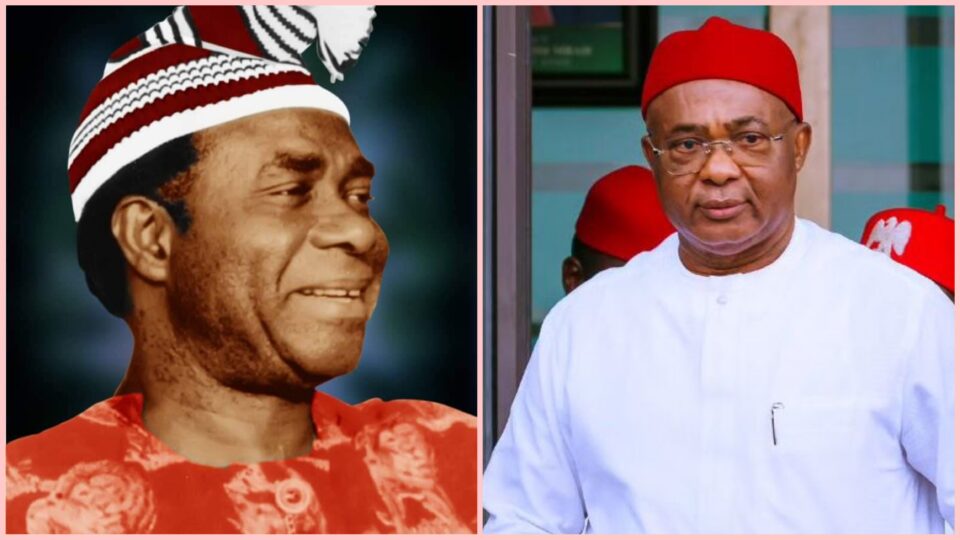
By Joachim OLUMBA
The government of Imo State under the leadership of His Excellency, Distinguished Senator Hope Uzodinma had penultimate week led the people of the state in enthusiastic celebration of the attainment of 50 years of its creation and the attendant giant strides in diverse spheres of the collective existence of the people.
The Golden Jubilee of the state afforded the government and people a unique occasion to reflect on the journey so far undertaken by successive governments, and sons and daughters of the state, both living and deceased. It was a golden opportunity to ruminate on the overall efforts, services, sacrifices, contributions, achievements and impacts of major players and some legendary personalities in governance and administration; economic and infrastructure development; commerce, trade, investment and industry; academic advancement and excellence; arts and culture; innovation and so on.
The highpoint of the Golden Jubilee was the recognition of some former administrators and most outstanding people of the state not only for their remarkable feats in different callings and endeavours, but for their exceptional contributions to society and humanity, especially to the state, nation and the globe at large.
From all available records and facts, all those who bagged the Imo State @ 50 Star Honours awards were highly deserving of the prestigious recognitions and rewards. None of the eminent awardees is without distinguished track records of numerous solid and visible personal achievements, and concrete contributions to the growth, development and progress of the different segments of the state and beyond.
Indeed, there’s no doubt whatsoever that those saddled with the onerous responsibility of selecting beneficiaries of the special honours awards by the state government executed the task splendidly. It was obvious that they must have had sleepless nights and great difficulty in the selection of the few awardees from the legion of prominent personalities associated with innumerable attainments and significant contributions to worthy public causes in the state. Surely, their performance is worthy of high commendation.
One of the illustrious sons of the state who was honoured posthumously during the state’s Golden Jubilee was Chief Collins Obih (Ochiagha Dikenafai, and the first Igbo man to be reverently and appropriately known as Ozo Igbo Ndu). He bagged the Distinguished Star of Imo State (DSI) category of the honours awards.
It is not unlikely that some people may not be fully aware of the reasons for Chief Collins Obih’s inclusion in the reputable honours awards. This is why I have decided to use this medium not only to express profound appreciation to Governor Hope Uzodinma for finding him worthy of the monumental recognition, but to enumerate his legion of concrete achievements necessitating the honour. I am, therefore, in glowing terms, extending a great debt of gratitude to the Governor of Imo State, His Excellency, Distinguished Senator Hope Uzodinma, for not only initiating the highly commendable Golden Jubilee Star Honours awards, but for the quality and impressive array of famous indigenes who are beneficiaries of the prestigious awards. I am particularly exceedingly thankful to him for the inclusion of Chief Collins Obih on the Imo State Golden Jubilee Star Honours list.
There’s no doubt that Chief Collins Obih deserved the special recognition and honour. For the benefit of those who might be wondering why he was honoured as one of the greatest and most outstanding sons of Imo State, permit me to chronicle this elaborate insight into the world of this man who did to Igbo people what nobody is ever known to have done for their transformation and wellbeing.
Chief Collins Kenneth Nnadi Obih was a foremost Nigerian banker. He had a brief stint with the Colonial Army, or better still, the Nigeria Regiment of the West African Frontier Force (WAFF) before veering into the banking industry where he had spells with Barclays Bank and Pan Nigerian Bank. He joined the African Continental Bank (ACB) in 1953 as Senior Accountant. He rose progressively to become General Manager and Chief Executive Officer of the bank in 1965, on acting capacity, and substantively, in 1966. It was in this position that he made his mark as a most outstanding banker in Nigeria’s history. Throughout his era at the helm of affairs in ACB and the entire banking sector, he was widely regarded as a father figure by countless industry practitioners.
As a foremost Nigerian banker, Chief Collins Obih became the first indigenous President of the Institute of Bankers, which had members drawn from Nigerian and foreign industry practitioners. The institute was renamed the Nigerian Institute of Bankers, and eventually, it became known as the Chartered Institute of Bankers of Nigeria. He was the first Nigerian, nay, West African to be accorded the prestigious Fellowship of the institute for his trailblazing achievements and impact in the industry in Nigeria. He was also the first Nigerian Fellow of the Institute of Bankers of London and was bestowed with honorary fellowship of related professional bodies in Nigeria, Britain and United States of America.
Most importantly, his greatest achievements as a banker of distinction came to the fore during the Biafran civil war and the years following the end of the war. Prior to the internecine war, Collins Obih had worked in London as the pioneer Manager of the bank’s branch there. In fact, he established the London Branch and made it a very popular financial institution amongst Nigerians and West Africans in Britain. This offered him the leverage to be widely exposed to key players in the British banking and finance sectors. Hence, during the civil war, Biafra depended solidly on his exposure to enjoy significant financial support from some foreign sources. He was therefore placed at the head of the management of Biafra’s foreign exchange transactions.
Of his role in this regard, the great Biafran leader, Chief Chukwuemeka Odumegwu Ojukwu said: *”As it transpired throughout the crisis and subsequent war, Collins Obih played a most important role in Biafra’s foreign exchange management and all foreign transactions. This entailed a lot of mental and physical movements. Obih was indefatigable and because of him, Biafra was able to do those things which are today considered as miracles, including being in existence for thirty months.”*
Collins Obih’s most profound impact as a great banker was indubitably associated with his roles in the rehabilitation of war survivors and of the battered economy of the defunct Eastern Region, especially Igbo land. Notwithstanding the dynamism, ingenuity, industry, resilience and doggedness of Igbo people, the single most pronounced factor behind the resurgence of the business and commercial sectors across Igboland after the catastrophic and debilitating civil war in 1970, was the strategic policies and deliberate efforts initiated by Chief Collins Obih as the helmsman of the ACB.
All Igbo people were out of business throughout the period of the civil war. Economic activities had ground to a halt throughout Igboland while the war lasted. Cities had been reduced to rubble. Igboland was desolate.
Some post-war policies and actions of the Federal Government toward Igbo people compounded their woes and predicaments. The most callous of those policies were the crass reduction of the entire monetary savings or wealth of every single Igbo person, business or institution to a paltry £20. There was also the obnoxious “Abandoned Property” policy, whereby their immovable properties were confiscated by some state governments, especially in the then Rivers State. There were other offensive policies introduced by government to economically stifle and utterly frustrate war survivors who were of Igbo origin.
In the face of the seemingly endless harsh policies of the Federal and some State Governments against Ndi-Igbo, Collins Obih engineered the innovative policy which his bank christened “Third Party Guarantee” (TPG). By this policy, the African Continental Bank (ACB) provided all pre-war customers of the bank the rare opportunities of accessing funds not exceeding £10,000 each for their businesses, without the mandatory requirement of provision of stringent collateral securities. Under this liberal policy initiative, those seeking for loans not exceeding £10,000 from the bank only had to be guaranteed in writing by well-known customers. Through this peculiar policy, people got loans from Collins Obih’s ACB to rehabilitate their battered businesses. It was so popular and successful that soon after the civil war, markets were reopened and businesses bounced back across Igboland and beyond. In less than half a decade, industries sprang up in many urban and rural areas of the then East Central State that was later split into Anambra and Imo States before they eventually became five states. The TPG and some other unique financial packages and expert professional services were how Chief Collins Obih turned around the misfortunes and pathetic conditions of the majority of Igbo entrepreneurs after the civil war.
Of his numerous outstanding contributions, notable Nigerians have placed on record some quite prodigious glowing references and testimonies. Chief Solomon Lar, who was a Federal Government appointed Chairman of ACB immediately after the war, and later Governor of old Plateau State stated thus: *”Nigerians cannot easily forget the yeoman’s role he played in revitalising many businesses in the former Eastern states, which suffered serious setbacks after the Nigerian civil war. His contributions to the economic recovery of these businesses and the consequent post-war posterity of our brothers in the Eastern part of the country and indeed many entrepreneurs in other parts of Nigeria was as foresighted as it was rewarding.”*
In his own words, Chief Chukwuemeka Odumegwu Ojukwu gave graphic description of Chief Collins Obih’s place in history thus: *”I am one of those who have the privilege and honour of knowing, working and associating with Chief Collins Obih. My late father held him in great respect. Throughout our association, I have admired his integrity and have been inspired by his tenacity of purpose, his doggedness and indefatigability at work. He was one of the few men of our time who can be cited without equivocation as a great Igboman. He made quiet and unparalleled sacrifices for the survival of our people, when they survived, he ensured by toiling night and day that our people prospered, when they prospered, he offered again himself as pilot of our destiny.”*
Former President of Nigeria, Alhaji Shehu Shagari also offered his own insight into the peculiar impact of Chief Collins Obih by describing him as *”a hard worker and a dedicated banker who spent his whole life in the pursuit of progress and prosperity for his people and…he lived to see innumerable beneficiaries of his selfless service.”*
General Ibrahim Badamosi Babangida, a former military President of Nigeria also acknowledged Chief Collins Obih’s *”years of invaluable contributions to the socioeconomic and political development…of our country.”* He also categorically conceded the fact that Chief Obih *”…indeed bequeathed lasting legacies to his family and to public service in Nigeria.”*
Commodore Amadi Ikwechegh, a one-time Governor of Imo State also submitted that; *”…Chief Collins Obih was a true patriot. Whether in public and private capacity, he served Imo State and Nigeria with clear commitment and characteristic enthusiasm. Perhaps, his most outstanding public service was when he was with the African Continental Bank (ACB). For a while there, his name became synonymous with the bank.”*
A writer, Mr. Alaso Ume once captured the uncommon disposition of the famous banker towards the application or demonstration of compassion and empathy in handling his official responsibility. He cited one such instance thus: *”When the Ekeoha market in Aba suffered its first fire disaster after the civil war, Collins took the bold decision of extending generous credit to the traders who would otherwise have been ruined. In one bold move, he doubled the overdraft facilities of those of the traders who were customers of the bank. This made it possible for Ekeoha to rise from its ashes.”*
From the foregoing, there’s no gainsaying the fact that Chief Collins Obih stood out prominently as a banker of distinction and an illustrious son of Imo State, nay, Nigeria. In fact, it’s pertinent to further cite the opinions of some famous Nigerians to buttress this unimpeachable assertion.
Dr. Nnamdi Azikiwe, first President of Nigeria and founder of the African Continental Bank before it was acquired by the Eastern Region government, had this to say of the distinguished banker; *”He (Collins) more than any other person helped me to make the ACB a reality in the Nigerian economy.”*
Dr. Michael Okpara, one-time Premier of the defunct Eastern Region was the person who first appointed Chief Collins Obih as Acting General Manager of ACB. He once described the frontline banker as *”a financial wizard and a most competent and able administrator.”*
It was Chief Chukwuemeka Odumegwu Ojukwu who appointed Chief Collins Obih as the substantive General Manager of ACB when he became the Military Governor of Eastern Region. He said: *”There was absolutely no doubt about Chief Obih’s ability, expertise, openness, flexibility and superior exposure in the financial areas of our national politics. He had carved out for himself a clear position as a leading professional within the bank.”*
In his own statement acknowledging the preeminence of Chief Collins Obih in the banking subsector of the nation’s economy in his days, Chief Solomon Lar, the first post-war Chairman of the Board of African Continental Bank (ACB) remarked as follows: *”One fact is however incontestable, and this is that he was a true Nigerian- highly detribalized in a country where many in his class, always sought refuge and drew strength from religion and ethnicity. Collins was a banker of unparalleled talent and peerless experience. He was a virtuoso, a top-drawer, a rare gem and indeed a superstar. He was many strokes above others in the profession.”*
A one-time Managing Director of ACB, Chief C.C. Okafor described Chief Collins Obih as an *”institutionalised father-figure…in the Nigerian banking industry in the years following the end of the war, and has remained a source of guidance and inspiration to those of us coming after him.”*
Indeed, Chief Collins Obih had a glittering and distinctive banking career which an observer, Alaso Ume, succinctly captured thus: *”By the time Mr. Obih left the ACB in 1979, he had achieved national and international stature as a manager of complex organizations, as a prudent and imaginative financier, as a hardheaded technocrat, as a man of patriotic ideas and action, as an intellectual and, above all, as a humanitarian of wide and generous sympathies.”*
Beyond his unprecedented and incomparable achievements in the field of banking and finance, Chief Collins Obih attained great heights and left notable imprints in other spheres of our national life. In politics, business, community service, philanthropy and so on, his roles, contributions and impact are seemingly inexhaustible.
In the Second Republic, he was one of the founding fathers of the leading political party, the National Party of Nigeria (NPN). He was a National Vice Chairman of the party, and a governorship candidate for the party in Imo State in 1983. Prior to his gubernatorial candidacy, he served as Personal Assistant to the President, Alhaji Shehu Shagari, otherwise known as Presidential Liaison Officer (PLO), in Imo State. It was through the PLOs that the Federal Government at the time executed projects such as low-cost housing schemes, colleges and higher institutions, federal secretariat complexes, roads, etc, in the various states of the federation. Collins Obih played active roles to ensure the accomplishment of quite a number of Federal Government projects in the old Imo State, especially the Federal University of Technology, Owerri; Federal Secretariat; and others. He attracted and ensured the completion of numerous federal government housing units, making Imo State the highest beneficiary of such projects after Lagos State, which was the then Federal Capital Territory.
Of his efforts in bringing about the take off of the Federal University of Technology, Owerri, the pioneer Vice Chancellor, Prof. Umaru Gomwalk once submitted: *”I would like at this stage to put on record the great interest shown by the Personal Assistant to the President in Imo State, Mr. Collins Obih, in the development of this site. His periodic visits to the site, and meetings with all the contractors involved in the development of the site during the time when the contractors were threatening to abandon the project, as well as being constantly in touch with the Vice Chancellor to monitor the progress of the project, have contributed immensely to what we are now seeing.”*
Beyond his political impact and influence, Chief Collins Obih made extensive invaluable contributions to the nation’s corporate world. Apart from his astute support and services to countless business concerns in the private and public sectors, he participated actively by serving on the boards of a number of companies at various times. He was director of Universal Insurance Company Limited, Premier Brokers Ltd, Biscuit Manufacturing Company (BISCO) of Nigeria Ltd, METCOME Nigeria Ltd, Crushed Rock Industries Nig. Ltd, Hallmark Assurance Company Ltd, Transhill Ltd, Hic Oil Co. Nig. Ltd, Ideal Flour Mill Limited, Ideal-Eagle Agro-Allied Limited and Eastern Bulkcem Company Limited (manufacturers of Eagle Cement brand). He was the Managing Director and Chief Executive Officer of Kema Investment Group and Sunlife Investment Limited. He was also variously the Chairman of Kema Group of Companies and Transglobe Investment and Finance Co. Ltd.
His vast contributions to nation-building extended to membership and services through special committees and professional bodies. He was President of the Institute of Bankers in Lagos, as well as President of the Nigerian Bankers (Employers) Association. Furthermore, he was a member of the Council of the Lagos Chamber of Commerce, Industries and Mines; a member of the National Committee on the Review of Technical and Commercial Education in Nigeria; and member of the Federal Panel for the Conversion of the Nigerian Building Society into a Mortgage Bank. It was this panel that brought about the establishment of the Federal Mortgage Bank.
Certainly, the services and contributions of Chief Collins Obih were enormous and cannot be exhausted in a short article as this. However, they are widely acknowledged and appreciated by so many eminent, influential and highly placed personalities from different parts of the country. One of such views was expressed by Prof George Obiozor, an international affairs guru and diplomat. He stated inter alia: *”Chief Collins Obih was clearly a man with many startling qualities, who made remarkable impact on humanity and society as a soldier, banker, businessman, politician, philanthropist, etc.”*
General Sani Abacha, a late Head of State and Commander-in-Chief of the Armed Forces of the Federal Republic of Nigeria also offered an opinion in relation to the huge impact of this renowned banker and outstanding citizen by stating that; *”Collins Obih was indeed an achiever whose contributions to national development covered many areas of endeavour….”*
A great nationalist, frontline politician and respected technocrat, who served as Central Bank Governor and Minister of Finance, Alhaji Adamu Ciroma aptly described Collins Obih as *”a humane banker of great understanding and a statesman who contributed so much to the development and maintenance of national harmony and cohesion and a gentle selfless community leader.”*
Sir Joe Nwankwu, a famous industrialist and seasoned entrepreneur, equally couched the symbolic essence and personage of Chief Collins Obih by stressing that: *”You have distinguished yourself in various fields of human endeavour and therefore can be described as an embodiment of…experience, humility and sense of purpose…You are known for the indefatigable way in which you work, the objective manner in which you approach issues and your refusal to be silent over injustices.”*
From the foregoing, I believe strongly that it is obvious that the honour bestowed on the late Chief Collins Obih is one very well deserved. In fact, apart from his choice, or inclusion in the Imo State @ 50 Star Honours award list, the Governor of Imo State did an unquestionably excellent job in the selection of the awardees. This certainly gave the monumental Golden Jubilee honours awards the much-desired meaning and treasured value it ultimately enjoyed. It’s really one honours list that has quality, satisfying the expectations of a wide cross-section of the people of the state.
Kudos to His Excellency, Distinguished Senator Hope Uzodinma for a qualitative and comprehensive Imo State @ 50 Star Honours Awards. It’s really worth all the memory and attention. Congratulations, once again, Your Excellency, for a job, well done.
Joachim OLUMBA, Retired Comptroller of Immigration CIS), Enugu state Command (KSJI)
(Emetumba-Dikenafai & Omekannaya-Nchoke) is the author of the unpublished biography of Chief Collins Obih.


